
nokia infinera

Here’s a detailed overview of the acquisition of Infinera Corporation by Nokia Corporation — what it is, why it matters, and what the implications are (especially for optical networks, data-centres and high-speed broadband infrastructure).

What’s the deal?
-
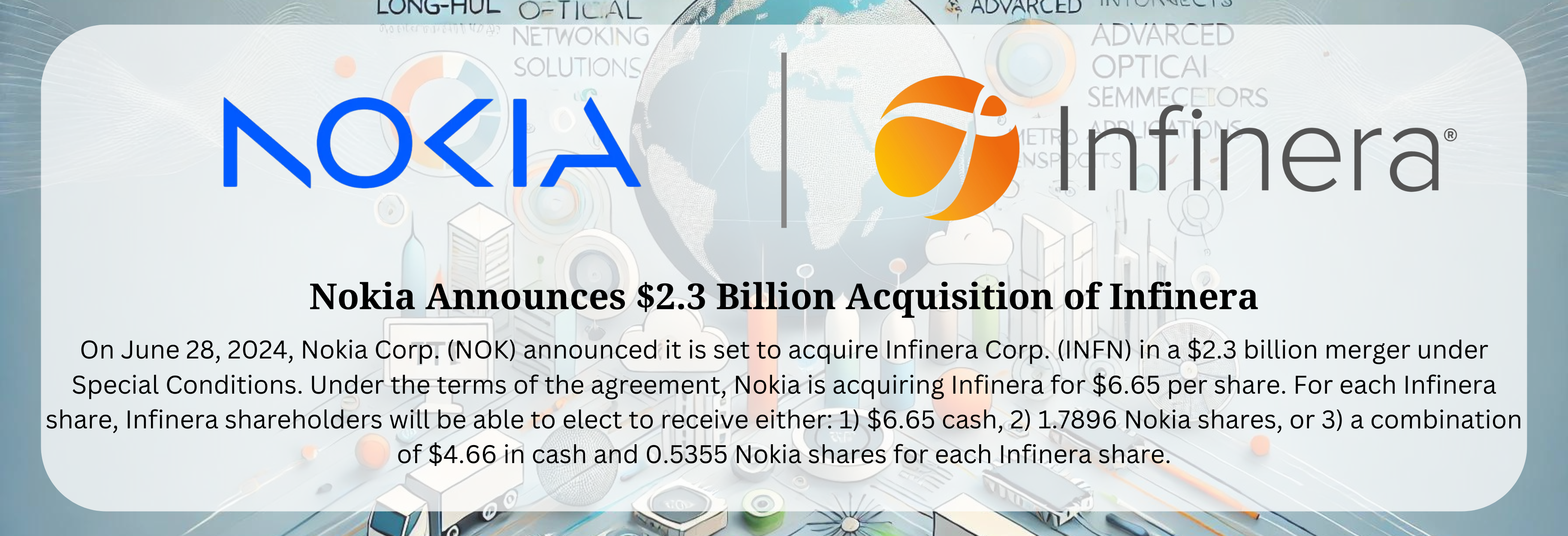
On 27 June 2024, Nokia and Infinera announced a definitive agreement under which Nokia would acquire Infinera for US$6.65 per share, valuing the enterprise at about US$2.3 billion. (Nokia Corporation | Nokia)
-
The acquisition was aimed to close in the first half of 2025, subject to regulatory and shareholder approvals. (ETTelecom.com)
-
On 28 February 2025, Nokia announced it had completed the acquisition of Infinera. (Nokia Corporation | Nokia)
-
Nokia’s announcement emphasises the combined company will become a “optical networks powerhouse” – leveraging Infinera’s optical technologies with Nokia’s broad customer base and research (through Nokia Bell Labs) to address new demands (e.g., data-centres, AI workloads). (Nokia Corporation | Nokia)
Why it matters — the strategic rationale
Here are the key reasons why this acquisition is significant:
1. Scale & market position in optical networks
-
By acquiring Infinera, Nokia increases its scale in the optical networks business by ~75% in the near term. (Computer Weekly)
-
This enables Nokia to compete more strongly against other optical-network vendors, and to expand presence in markets (especially North America) where Infinera has strength (~60% of its sales). (ETTelecom.com)
2. Technology & product synergies
-
Infinera brings in advanced optical semiconductor, photonic-integrated-circuit (PIC) technology, coherent pluggable optics and intra-data-centre optical systems. Nokia brings broad access, networks, research. The idea: together they can accelerate product roadmaps for high-speed optics (edge-to-core, within data centres) and power more demanding workloads (AI, cloud). (AInvest)
-
Nokia expects to realise net comparable operating profit synergies of €200 million by 2027, and over 10% EPS accretion by 2027. (Nokia Corporation | Nokia)
3. Positioning for future growth in data centres & AI
-
The move is timed as network demands shift — we’re seeing increasing data-centre traffic, AI-driven workflows, intra-cloud connectivity and low-latency/high-capacity interconnects. Optical networks become critical in this. Nokia states the acquisition helps it “meet the network and power demands of the AI era.” (Nokia Corporation | Nokia)
-
For service providers, enterprises, hyperscalers (large cloud players) the optical backbone is increasingly strategic. By combining Nokia + Infinera they can offer a more comprehensive solution.
Implications & what to watch
Here are some implications and things to watch out for:
-
Competition & regulation: The acquisition was scrutinised by regulatory bodies (e.g., the EU). The EU approved the deal unconditionally in Feb 2025. (Reuters)
-
Integration risk: Merging large technology firms always has risk: culture, streamlining product portfolios, overlapping engineering teams. Nokia will need to manage Infinera’s integration to realise the targeted synergies.
-
Technology transitions: As optics evolve (higher capacities, lower power, new materials), the combined entity must stay ahead of competitors. The risk: falling behind in innovation. Nokia seems betting on that by acquiring talent & technology from Infinera.
-
Geographic and customer diversification: Infinera had strong U.S. presence. Nokia had strong presence elsewhere (APAC, EMEA). The combination improves cross-region footprint. But local market dynamics differ (e.g., telecom regulation, fibre rollout pace).
-
Impact on other markets: For markets outside major western economies (for example Nigeria/Africa), this combination could trickle down as better optical network solutions become commercially viable (lower cost per bit, improved power efficiency) — hence for ISPs upgrading fibre networks, this may matter.
What this means for you (in broadband / fibre networks context)
If you are involved in broadband infrastructure, or simply interested in how this affects future network roll-out (including in markets like Nigeria), here’s how this plays out:
-
ISPs and fibre network operators will increasingly demand optical network equipment that offers higher capacity, lower cost, lower power consumption, and better manageability. The Nokia-Infinera combination is aimed to deliver that.
-
As fibre broadband becomes more widespread (especially in African cities, urban + suburban zones), equipment suppliers with stronger portfolios can support more efficient roll-outs, potentially reducing cost and improving access.
-
Future proofing: With increasing data usage, video streaming, cloud apps, remote work & smart-city infrastructure — the network backbone (including optical) matters. Having vendors who can supply high-capacity optics, pluggables etc means better backbone for future expansions.
-
For end-users: While you may not see the vendor name on your home modem, the ripple effect means faster, more reliable networks, better backhaul and fibre infrastructure — which can translate to better broadband service.
-
For tech watchers: It shows that major network equipment players are consolidating to handle the next wave of network demand (AI, data-centre, cloud). This might accelerate when markets like Africa upgrade fibre and data-centres.
Summary
In short: The acquisition of Infinera by Nokia is a major move in the optical networking space. It strengthens Nokia’s scale, broadens its technology base (especially in optics), and positions it for growth in data centres and high-capacity networks. For anyone interested in broadband infrastructure, fibre networks, or high-speed connectivity, it’s a significant development.
Post a Comment